

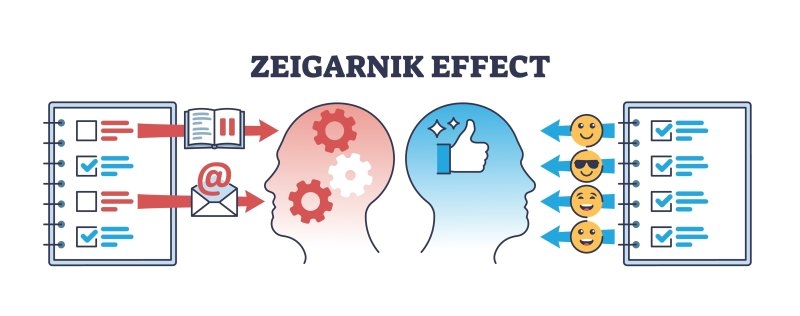
Ever put something down but not been able to stop thinking about it? This is related to the Zeigarnik effect, a psychological phenomenon that seems to suggest that incomplete tasks stay with us mentally.
Read on to see if this can also be the reason behind those everyday distractions, memory issues, your studying style, procrastination, or the satisfaction of finishing what's been in your head.
The Zeigarnik effect is the phenomenon where unfinished tasks are easier to remember than completed ones. Psychologist Bluma Zeigarnick is known for the effect after her research into how interruptions can affect our memory. According to the effect, it's the nature of incomplete goals that keeps them fresh in our minds.
When you're writing an email and haven't finished it, then you begin working on something else—many times you can't stop thinking about the email you have yet to finish. That's the Zeigarnik effect—that's why it's sometimes related to memory, attention, motivation, and goal completion.
The first thing to understand about the way the Zeigarnik effect works is that it begins with unfinished goals. An interrupted activity may still be capable of occupying your mind as something that needs to be brought to consciousness.
But research has shown different results. The phenomenon is not universal, for motivation and task type or personal situations affect memory. So the Zeigarnik effect and memory should be seen as a tendency in psychology and cannot be made into a law.
When something is left unfinished, you may think about it in your mind or see cues that are associated with it. This can make unfinished tasks feel more prominent than things you have finished.
Take the case of remembering the report you still have to complete but not remembering everyday tasks you did earlier. This shows how an incomplete task impacts your memory, but the effect can be strong or weak.
Finishing a Task Ends the Play. Have a defined endpoint. If you can't continue doing it, then there's only one thing to do, and you can direct your focus on the next goal without constantly asking what's left to do.
This is part of the reason why the Zeigarnik effect and memory are so often linked. The reason is that an unfinished task is still an open goal which may be occupying mind space. A task that was finished has a greater feeling of closure.
Breaks can be distracting. Your mind might keep returning to the activity if you have not completed your assignment, book, conversation, or project.
However, breaks are not necessarily good all the time. Transitions from one task to another can be a source of distraction. A planned pause and response plan is more effective than finishing work and leaving the unfinished part.
The Zeigarnik effect in everyday life isn't always a blessing. You may not want a backlog of incomplete tasks. If you're unsure of how or when you'll finish those tasks, that backlog may also clutter your mind.
Jotting down a task you haven't finished yet and thinking about what you will do next can help take the load off. Having a plan in place may help you avoid having to carry the task around in your head.
The Zeigarnik effect productivity relationship can be of use if you have a big project that seems to be too much to handle. Rather than trying to do it all at once, start with one small, concrete task.
For example:
These small starting gains can make a project easier to re-engage with. This is an example of a practical method for applying the Zeigarnik effect for productivity that is not stress or pressure.
However, there is a quirky connection between the Zeigarnik effect and procrastination. You've probably procrastinated at some point when the task was difficult, boring, confusing, or daunting. Once you begin, you begin to have a different relationship with the task—it's now a goal to do it rather than a task to avoid.
If you're asking yourself, "How can the Zeigarnik effect assist me with procrastination?" take some time to complete an activity you are able to finish in 5 minutes. Before you finish, jot down the next thing you can do to finish up. When you return, you will not have to make a decision on what to do next.
This take on the Zeigarnik effect and productivity is more actionable. The point isn't to induce anxiety with a looming to-do list. Instead, a pending task acts as a reminder while you still have power over when to resume.
The Zeigarnik effect has implications for studying and learning because uncompleted tasks might stay more easily accessible in our minds. Instead of studying for a few hours, you can break your work into shorter, concentrated sessions.
Useful strategies include:
If you are asking how the Zeigarnik effect influences studying and learning, do keep in mind that merely stopping work in the middle of the task doesn't necessarily translate into better learning. Regular studying, retrieval practice, and review all matter.
The Zeigarnik effect in daily life might be observed in more straightforward scenarios. An unanswered text, a household task left undone, an incomplete application, or an unfinished work project may keep nagging you.
Another example of something you know is entertainment. The story is not finished with some sort of happy ending, so it leaves a question open, for example, with a cliffhanger.
You can apply this insight to the daily to-dos. Rather than remembering every task that has been put off, write them down in one location and define a next step for each task.
The Zeigarnik effect explains how. It can be good to keep open projects in your mind (as we've just seen), or keeping something on your mind can be draining. But a simple system can help you keep related things apart.
Jot down what's incomplete, the next step, and when you'll come back to it. This provides an outside prompt instead of having to keep that image in your head.
The Zeigarnik effect and the memory benefits can help you manage your tasks more effectively. You don't have to complete everything right now. You have to be aware of what is still to be done and make a plan to complete it.
The Zeigarnik effect might give us insight into why things you haven't finished might linger in your mind, and even be easier to remember than those completed. It has strong links to learning, studying, procrastination, and memory, but the evidence is inconsistent.
It should therefore be used cautiously and not assumed to be a hard-and-fast psychological fact. Clear planning and breaks are key to making it work without stress.
It might sustain an incomplete goal in your mind, but this alone doesn't enhance your focus. To maintain concentration, you need drive; this is influenced by distractions, the complexity of the task, environmental issues, and how you juggle conflicting commitments.
Rather, an uncompleted conversation can nag at you simply because it doesn't have that sense of completion. But this doesn't always mean that you will remember every uncompleted conversation more than you will a completed one.
Children can be left with unfinished tasks in the air, so to speak. The child's reaction to this will vary to some extent depending on age, level of development, motivation, and the difficulty of the task, but it shouldn't be assumed that the effect will be the same for every child.
Lost tasks in your head. Write down any undone jobs, and you won't have to remember them in your mind. A list that's clear on what's to be done next can help you stay on top of things and avoid giving them more than you can bear.
The effect is familiar to psychologists, but subsequent research has led to inconsistent results. Some have supported the effect in part, whereas others failed to replicate the pattern. It may therefore be regarded as a convenient psychological construct, rather than a reliable law.
This content was created by AI